
Should we prescribe antidepressants like statins?
Making sense of the placebo response in antidepressant clinical trials

What does it mean for a medication to work? If, like me, you have an interest in evidence-based medicine, you would turn to randomized controlled trials (RCTs) to determine whether a medication has specific effects beyond those seen with a placebo. Specific biological effects are what define a “medication.”
In the case of antidepressants, it’s been shown that antidepressants outperform placebo by about 2-3 points (or ~0.3 standard deviations) on the Hamilton Rating Scale for Depression (HAMD) in clinical trials. This has led to endless debate about the meaning of that 2-3 point difference. Is it clinically significant? Does it reflect trial artifacts like effective unblinding? Does it underestimate benefit in certain subgroups? Is there a larger effect among more severely depressed individuals or on core depressive symptoms?
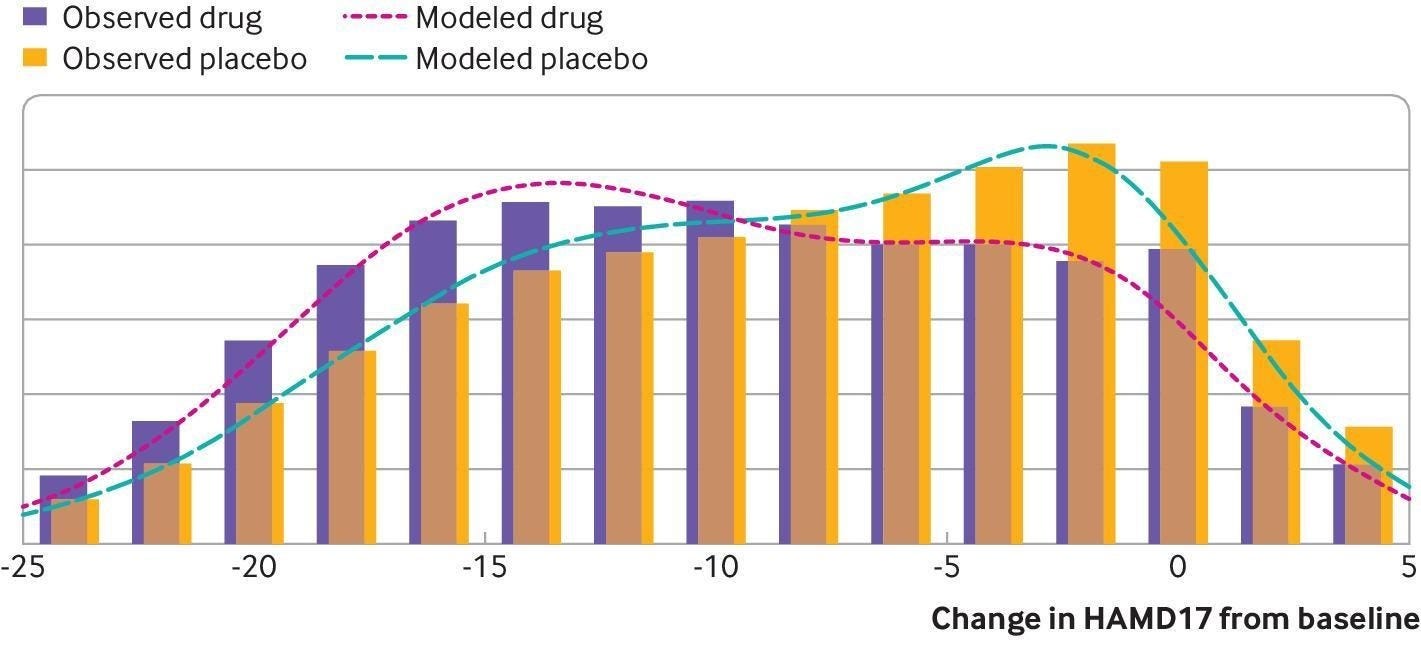
Lost in this debate is a much more important finding from the same studies. About 80% of the improvement seen with antidepressants is also seen with placebo: 8 points versus 10 points on the HAMD. While this may sound controversial, it isn’t. This figure is not disputed by researchers and is a well-replicated fact.
The placebo response
To be clear, this 80% isn’t just the placebo effect, which refers to specific psychological mechanisms related to conditioning and expectancy from receiving an inert treatment. Instead, it encompasses a range of factors in a clinical trial setting including the selection of healthier patients; the natural course of the illness (depressive symptoms often fluctuate and improve over time); significant attention and contact from clinical trial staff; artifacts of the clinical trial (e.g. dropouts of the least improved, regression to the mean, the Hawthorne effect); and the placebo effect. This sum of factors, which reflects all of the improvement seen in the placebo arm of RCTs, is called the placebo response. (I’ll use the terms non-pharmacological and contextual factors to refer to this same concept.)
Given this wide range of factors, it’s proven challenging to isolate the specific elements responsible for that 80% figure. As reviewed in a great paper, several meta-analyses have compared differences in the design of antidepressant RCTs to evaluate these factors. They point to the role of patient expectancy, therapeutic contact, and natural improvement as underlying the placebo response. A big focus has been on the frequency of clinical contact. In a thought-provoking review, Michael Sugarman showed how subjects had a huge amount of contact with staff: an average of 0.82 follow-up visits lasting 30 minutes for every week in the trial, or about five visits in six weeks. Unfortunately, the best RCT trying to measure the role of expectancy related to taking a pill had significant limitations, like major baseline differences in expectancy.
What is clear is that depression is extremely sensitive to non-pharmacological factors; these factors are four times more important than the antidepressant effect itself. Such large non-pharmacological effects are seen in common disorders like PTSD and generalized anxiety, but not in psychosis or obsessive-compulsive disorder, where only about 50% of the improvement is seen in placebo arms.
Misunderstanding how antidepressants “work”
I provide this background to argue that there’s a bit of a bait and switch in how clinicians understand antidepressants to “work.”
We say that antidepressants work because of the statistically significant 2-3 point difference between drug and placebo. This is what led to FDA approval and what is typically cited as evidence that the medication has specific biological effects.
But to argue that antidepressants have clinically significant effects, we cite the total improvement seen in RCTs, as with response and remission rates, even though these primarily reflect non-pharmacological effects rather than medication effects. For instance, antidepressant decision aids describe antidepressant outcomes like “6 out of 10 people will feel better.” The FDA approved the new antidepressant Auvelity, in part, by viewing the total improvement with the medication to be “clinically meaningfully.”1
In other words, we say that antidepressant efficacy is due to their biological effects, and then cite response and remission rates as proof of this, even though 80% of the improvement is due to non-medication factors.
Researchers complain about the size of the placebo response in antidepressant trials, but it’s clear why pharmaceutical companies conduct such studies: a trial that perfectly removes the placebo response would have a 0 point improvement with placebo and a 2 point improvement with antidepressant on the HAMD.2 This would be considered a useless drug. In clinical trials, the reality is that factors that improve outcomes with antidepressants also improve outcomes with placebo. Beyond the consistent 0.3 standard deviation difference, the only known way to improve outcomes with antidepressants is to enhance non-pharmacological effects.
To frame this differently: the key lesson of antidepressant clinical trials is not that they show that antidepressants “work” because of a small drug-placebo difference or that they “work” because of overall rates of response. Rather, they show that the only setting in which antidepressants meaningfully improve depressive symptoms involves a large non-pharmacological response.
Clinicians prescribe as if non-pharmacological effects don’t matter
Once you accept that antidepressant effectiveness in clinical trials is driven by non-pharmacological factors, the current way we prescribe antidepressants does not make sense.
Clinicians prescribe antidepressants as if the biological effects alone cause the improvement, rather than the context of care. For the vast majority of patients prescribed antidepressants, particularly in primary care, they are handed a prescription and seen several weeks to months later for a 10 or 15-minute “med check.” In settings where I have practiced, the baseline frequency of appointments is three months. Whereas patients in antidepressants RCTs get five appointments in six weeks, in real-world settings:
60% of patients [started on an antidepressant] completed less than one clinical follow-up per month, and almost no patients completed 10 visits over 12 weeks, which is the average for clinical trials (Iovieno et al., 2012). Another analysis examined 84 514 adults in the northeastern US between 2001 and 2003 following initiation of antidepressant treatment (Stettin et al., 2006). They found that the average number of outpatient medical visits during the first 12 weeks was 4.45, although only 0.97 of the visits were specifically with a mental health professional. Only 24% of individuals had a mental health appointment in the first 12 weeks.
This model can work when the active ingredient in the medication is driving outcomes. Few people would argue that the efficacy of chemotherapy, statins for secondary prevention in cardiovascular disease, or antibiotics for pneumonia are primarily dependent on the context of care.3
But this prescribing style does not make sense when the vast majority of the benefit is due to non-pharmacological factors. We are prescribing antidepressants for patients as if they are statins for coronary artery disease, where the isolated pharmacological effects of the medication are causing all of the improvement. We think we’re following the evidence by prescribing a medication that has been proven effective by the FDA, but we’re getting it backwards.
Rebuttals
You might argue: Sure, non-pharmacological factors may be important in mildly depressed patients seen by a PCP, but not in more severely ill patient or in patients trialed on multiple medications. But this doesn’t appear to be true. Several large individual patient meta-analyses are negative. The most favorable, Stone 2022, found that patients at the 95th percentile of depression severity increased by a measly 1.4 HAMD points more than patients at the 5th percentile of severity (2.5 points vs 1.1 points). Severity does not explain non-pharmacological effects. In any event, if you believe outcomes depend on severity, then it is extremely hard to justify specific pharmacological effects in any but the most severely ill patients.
But surely pharmacological effects explain outcomes in treatment-resistant patients. Contrary to popular belief, it isn’t clear that more treatment-resistant patients are less responsive to non-pharmacological effects, at least in clinical trial settings. To pick the most extreme examples: the two largest RCTs of deep brain stimulation for depression found that the benefit was a sham effect, as was the case for vagus nerve stimulation for TRD. Roughly 75% of the treatment benefit with esketamine is seen with placebo + antidepressant, as I discuss below. This is a similar figure with aripiprazole augmentation. Essentially 100% of the benefit for cariprazine augmentation for depression was seen with placebo.
What about pragmatic trials which use real-world patients and mimic real-world conditions. Pragmatic trials refer to efforts to conduct clinical trials in ways that reflect real-world care: more generalizable patients with comorbidities, open-label treatment where patients know that they’re getting a medication, and so forth. These have gotten more popular and influential in psychiatry.
But here’s the problem: our pragmatic trials don’t reflect real-world care, either. Sure, the patients are perhaps a bit more generalizable. But look at the frequency of treatments from the major pragmatic trials in depression. STAR*D scheduled follow-up appointments with administration of self-reported rating scales at 0, 2, 4, 6, 9, and 12 weeks with intensive measurement-based care and multiple doses increases during that time. The huge VAST-D trial in depressed Veterans had visits at weeks 0, 1, 2, 4, 6, 8, 10, and 12. (I have never once seen this psychiatry appointment frequency within the VA.) In the pragmatic OPTIMUM trial of geriatric treatment-resistant depression, patients had visits at weeks 0, 2, 4, 6, 8, or 10 with a trial clinician, with additional visits by the patient’s treating clinician. IsHak 2024’s pragmatic trial on antidepressants for depression in heart failure had 12 weekly 15-minute medication management check-ins with care managers, followed then by monthly check-ins.
So, our “real-world” pragmatic studies of antidepressants involve an intensity of care that simply does not exist. Based on what we know about non-pharmacological factors in antidepressant RCTs, if pragmatic trials show good outcomes, we either need to practice as they do or disregard their findings.
The route forward
My argument has a few implications.
First, we desperately need to determine what non-pharmacological factors lead to improvement with a placebo, because some may be modifiable (e.g. frequency of appointments) and some may not be. If improvement is due to the selective, healthy patient population in clinical trials plus natural improvement in depression, then the context of care (like visit frequency) probably matters less (as do medications, themselves). If it’s expectancy related to a new medication and the placebo effect directly, then the act of prescribing a medication is probably most important—but the actual medication picked may not matter enormously. If it’s the frequent contact with a clinician and the feeling of being closely cared for that drive outcomes, then simply handing patients a pill and checking in a few months may be ineffective care.
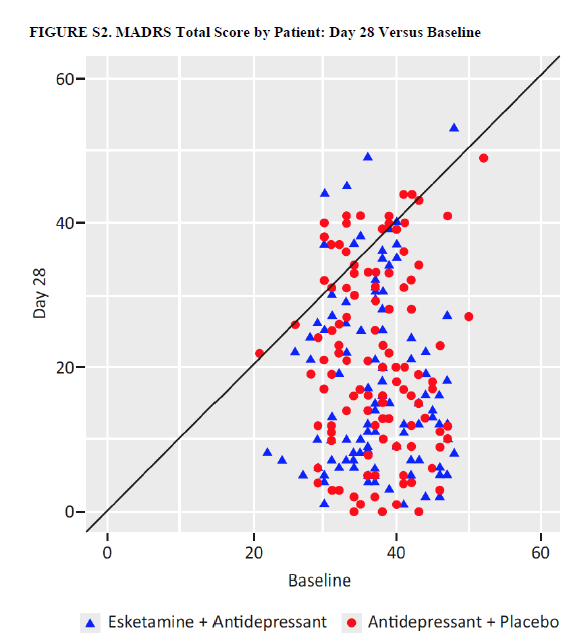
At a minimum, there should be a sense of urgency in determining which aspects of the clinical trial environment are driving the placebo response. It pains me when the discussion about a new treatment, like esketamine, is entirely focused on its pharmacological mechanism when the clinical trials show that about 75% of the symptom improvement is seen with placebo (plus antidepressant). Look at the figure below. Can you tell which color is esketamine or placebo? The placebo response is so much larger than the isolated medication effect, that they look almost identical. And yet, there seems to be no interest or curiosity in determining the source of ~75% of improvement.
I mean, shouldn’t we be curious why giving intranasal placebo plus an antidepressant leads multiple patients with severe depression to have zero depressive symptoms four weeks later? This trial, TRANSFORM-2, was the most positive adjunctive esketamine trial—I’m not cherry-picking a negative trial. Either our clinical trials are completely broken and useless (which should be a big deal), or non-pharmacological effects are really important (which is also a big deal). I could give lots of other examples, as I have written about here and here and here.
Second, the simple implication is that clinicians should be more attentive to non-pharmacological factors when prescribing antidepressants. The downsides to this seem to be minimal, and mostly logistical and financial (at a health-systems level). Clinicians should spend time generating (realistic) expectancy and hope. Schedule additional follow-up visits or nursing phone calls. Show attentiveness and understanding of the circumstances someone is facing. Display warmth and concern. Recommend behavioral activation. David Mintz has written brilliantly about this.
Third, and more controversially, you could make a case for using lower-dose antidepressants to leverage placebo effects while reducing medication risks.4 You could also make an argument that there is less value in prescribing to patients who have minimal expectancy or who need to be persuaded to take a medication.
Fourth, in the Sugarman paper cited above, his larger argument was that we underestimate the real-world effectiveness of psychotherapy compared to medications, because real-world practice resembles psychotherapy trials much more than medication trials. This would be a case for expanded use of psychotherapy prior to pharmacotherapy in real clinical practice.
Psychiatry is different from the rest of medicine, and that’s okay!
There are lots of reasons to be critical of the data in antidepressant clinical trials. I’ve written about many. But if we collectively cite these trials as evidence of antidepressants’ efficacy, then we should take their findings seriously: non-pharmacological factors are far more important than the pharmacological factors in determining outcomes. The only way to reliably improve outcomes with antidepressants involves increasing the size of non-pharmacological factors. And yet, we prescribe antidepressants in a way that is contradicted by all of the clinical trial evidence, which almost certainly leads to worse patient outcomes.
The reality is that the conditions in which antidepressants help people depend on the context of care. In all existing clinical trials, this means frequent contact points (plus healthy patients and presumably lots of expectancy and enthusiasm for medication). To practice evidence-based medicine, prescribers of antidepressants should attempt to model this care around the type of care provided by clinical trials. Otherwise, I worry that we are subjecting patients to all of the risks of antidepressants, with few of the potential benefits.
To dismiss the role of non-pharmacological factors in antidepressant clinical trials is to lose sight of what makes psychiatry different from the rest of medicine. Fundamentally, common psychiatric conditions are intertwined with the nature of being human. They are influenced by our biologically-programmed sensitivity to expectancy, social narratives, and contact with trusted figures.
I emphasize this because our current model of treatment implies that depression is akin to treating cancer or atrial fibrillation, or even schizophrenia or OCD: the pharmacological properties of the medication are doing the work, not the circumstances in which it is prescribed. That all that matters is that the right medication is prescribed, and not the context or ritual of the care.
My intention is not to be a clinical trial literalist. I recognize that all clinical trials are imperfect and will never perfectly reflect real-world clinical care. But we also need to listen to what antidepressant clinical trials tell us: non-pharmacological effects matter in depression care. Let’s figure out how to do this.
“The benefit of AXS-05 is anticipated to be clinically meaningful to patients. The clinical research literature suggests that a 6- to 9-point reduction in MADRS total score is considered to be clinically meaningful to patients with MDD. In Study MDD-301, over 70% of subjects receiving AXS-05 experienced a ≥7-point reduction in MADRS total score by Week 6.”
Of course, this is purely a thought experiment. Some portion of the placebo response represents statistical artifact inherent in any clinical trial.
I’ll risk making a fool out of myself by citing research outside of my areas of expertise, so please correct me if I am mistaken.
This explains the gap between clinician and patients’ perceptions of the efficacy of SSRI dose increases or antidepressant switches, and the negative data in blinded RCTs.
Can you really derive the magnitude of the medication-only effect by subtracting the effect size of the placebo arm? Seems possible the effects of psychological expectation, social treatment and role, and pharmacology are not independently additive. You'd have to have something like a trial of people running placebo-controlled experiments at home to figure this out, but it seems very possible to me that the pharmacology alone could knock out some of the same 'depression points' that are covered by being attended to weekly by a kindly psychiatrist etc. I forget what this is called statistically but it's like the opposite of gestalt, the whole is less than the sum of its parts.
Non-pharmacological factors are clearly important in MDD treatment response. However, I don’t think your 80/20 interpretation follows from the small magnitude of trial-level mean differences. In particular I think that you’re making an implicit assumption of homogeneity of response.
The clearest counterargument actually comes from the Stone et al (2022) IPD meta-analysis that you cite and include a figure from at the top of your post. The distributions of HAMD changes in the figure are clearly not unimodal. Indeed, it is visually apparent that large improvements are more probable in the drug than the placebo group. Stone et al and other researchers have modelled this as a tri- (or elsewhere bi-) modal distribution.
Quoting Stone et al directly:
"Those treated with drug were more likely to show a Large response (24.5% v 9.6% with placebo), however, and less likely to have a Minimal response (12.2% v 21.5%). Thus the observed advantage of antidepressants over placebo is best understood as affecting a minority of patients as either an increase in the likelihood of a Large response or a decrease in the likelihood of a Minimal response."
In short, and to quote a similar study by Thase et al (2011, BrJPsych):“small mean differences obscure large and clinically meaningful responses for a subgroup of people with depression.” This is why, as a clinician, I am generally more interested in the NNT for response and remission.