

This piece comes from several months reading TMS clinic websites. My critique is not of TMS, but of marketing that has gone too far. While I would prefer to write about clinical trials, I am convinced that this issue requires greater attention. I invite your feedback and disagreements. — KK
It struck me while driving through Los Angeles one day: when did psychiatrists start putting up billboards? I’m accustomed to injury lawyers, Netflix shows, and cosmetic surgeons. But psychiatrists?
Commercialization is not new to psychiatry. We’ve had three decades of “Ask your doctor if Prozac is right for you?” But underlying these ads was the recognition that your own psychiatrist was a bulwark against commercial forces. The pharmaceutical industry might be trying to sell antidepressants, but your doctor only cared about you getting better.
Something new is happening with transcranial magnetic stimulation (TMS) and other interventional treatments—what I call the “infomercialization” of psychiatry. Countless TMS clinicians have adopted the language and tactics of infomercials to aggressively market treatments directly to patients. This is not every TMS clinic, of course, but it represents a sizable portion of them. Let me introduce you to the new landscape of psychiatry.
1. “Ready for a One‑Day Transformation?” The language of marketing, not medicine
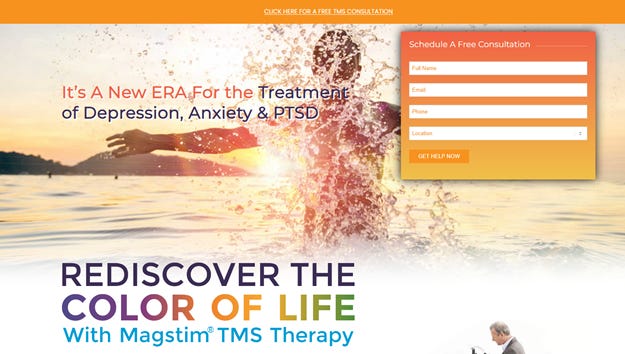
If you open a TMS clinic website, you’ll be asked, “Have you ever wished for a magic wand to wave away depression or anxiety? While magic wands are still the stuff of fairy tales, transcranial magnetic stimulation (TMS) therapy might be the next best thing.” This is the type of hyperbolic, non-medical language that practicing psychiatrists are using to describe a medical treatment for a psychiatric disorder directly to patients.
On TMS websites, you will learn that TMS is “life-changing” and will “completely transform” your mental health. TMS is not just a “profoundly-effective treatment,” it’s the “game-changer you’ve been looking for,” the “breakthrough you’ve been waiting for,” and the “solution you’ve been longing for.” You are encouraged to “unleash the power of TMS,” to “upgrade your depression treatment,” and to “prepare for a new era of health and happiness.”1
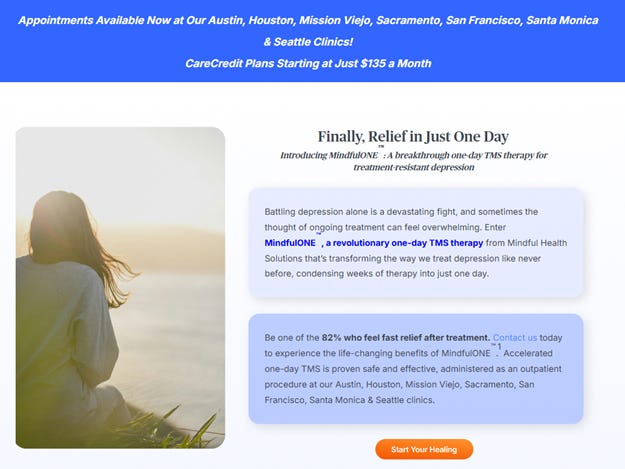
You will notice that TMS is not simply a psychiatric treatment but something much more powerful: TMS will “start your mental health transformation” and will “transform not just your mental state but also your daily life.” It will “restore your joy,” “renew your life,” and help you find “ultimate inner peace and lasting well-being.” Apparently, TMS is a “healing journey,” “journey of wellness,” “journey to recovery,” “journey to emotional well-being,” and “journey toward a brighter and more stable future.”
Even when clinical language is used to describe TMS, it is paired with distinctly commercialized language like “these results could be yours” or “be one of the 82% who feel fast relief after treatment” or “TMS works for our patients. It may work for you too.”
Remember, this language is not coming from television ads from pharmaceutical companies or TikTok posts from wellness influencers. These quotes are from clinical practices themselves, who should have an obligation to present realistic descriptions of a treatment. And yet, their language is several notches above the most hyperbolic ads for pharmaceuticals, which are held to an evidentiary standard by the FDA. Even the Federal Trade Commission appears to hold dietary supplements to stricter marketing standards than we see here.2
2. “Find out if TMS is right for you:” the language of direct-to-consumer ads
If you visit the page “TMS Therapy for Depression” for the clinic below, you will see five separate buttons for a “Free Consultation,” six separate listings of the clinic phone number (with prompts to “Call our Clinic” or “Call Now”), four separate links for a 2-minute quiz to find out if TMS is right for you, and five separate links for a pricing guide which links you to a quiz about insurance coverage.3
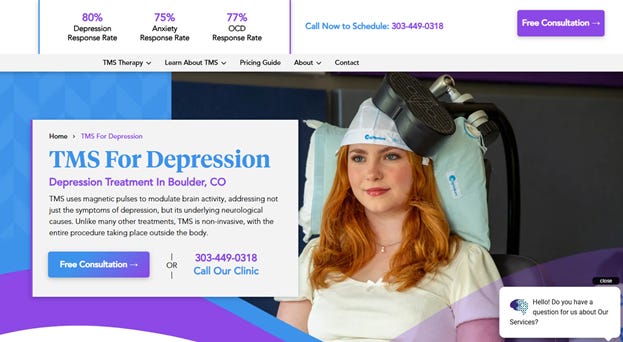
Beyond promises of transformed lives, TMS clinics aggressively try to convince patients that TMS “may be the solution for you.” Patients would get the impression that depression is not a complex disorder that requires a thorough diagnostic history and careful appraisal of treatment options. Rather, it is a simple, concrete entity for which an initial recommendation for TMS can be made with a few clicks, most of which are coincidentally the standard criteria that insurance companies use to determine coverage.4
It is the visual presentation of this which I find most jarring. Clinic websites feature large buttons encouraging you to take a “60-second” quiz to determine if you have “depression,” which typically links to a PHQ-9 hosted on the website of a TMS device manufacturer. Or they feature quizzes to “find out if TMS is right for you.” A representative 2-minute quiz consists of seven basic questions about your depression diagnosis and treatment before telling you that “TMS Might Be A Good Fit” or that a “TMS Evaluation is Recommended.”5 Take a moment to Google “Is TMS right for you quiz” to see the sheer number of clinics offering such quizzes.

Alongside these quizzes are repeated invitations for a “free consultation,” “free call,” or “no-obligation consultation.” You’ll hear the odd assurances that you will receive “honest answers” and that there’s “no pressure either way” (unlike those other guys, apparently). Many consultations seem to be with TMS technicians or “coordinators” where a focus appears to be whether criteria for insurance coverage are met while confirming a treatment history.6
You could mistake the websites of TMS clinics with those of injury attorneys and home remodeling companies—the language and presentation is uncomfortably similar. You might forget that these clinics provide medical treatment for a complex psychiatric condition, one that should require a careful diagnostic evaluation by a qualified clinician and collaborative treatment planning.
3. “TMS makes dreams happen:” Hyperbolic patient testimonials
Many TMS clinics promote patient testimonials and 5-star reviews which describe TMS in hyperbolic terms. As one clinic informs us, the “testimonials from individuals who have undergone TMS therapy are nothing short of inspiring.” It’s routine for testimonials to call TMS a “miracle,” “life-changing,” or “transformative,” as in the “most transforming thing that happened to me in my lifetime…it’s been life changing for me.” I encourage interested readers to read FTC rules on testimonials in the footnote.7
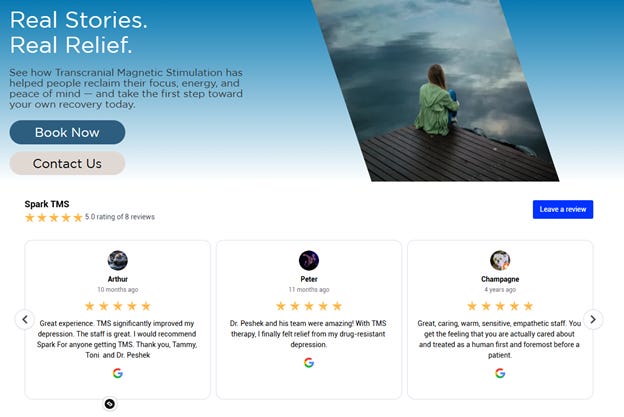
These testimonials are striking because medicine has historically shied away from patient testimonials for good reason. Testimonials can obscure the absence of evidence for a treatment. You can find hyperbolic testimonials for anything—supplements, NAD+ infusions, bizarre psychotherapies, and all forms of pseudoscience. That’s why they’ve traditionally been the domain of informercials, not medicine.
Moreover, such testimonials challenge the obligation of doctors to accurately describe the risks and benefits of a treatment to patients. Medicine relies on research to realistically inform patients about a treatment, which often runs counter to the rosy testimonials of TV commercials. This is why it surprises me to see a Harvard TMS clinic marketing the testimonial that “TMS makes dreams happen!” It is one thing for a TV ad to market this, but quite another for an academic clinic to do so.
4. “99% of Our Patients Experienced Positive Results:” Inflated claims of efficacy, presented as science
When TMS clinics do present outcomes data, they are routinely misleading, dubious, wrong, cherry-picked, exaggerated, or all of the above. This is the definition of “medical bullshit”—using the veneer of science as a marketing device. Clinics present simple, unbelievably good outcomes with zero citations, description of research methods, or context. These data are presented as simple scientific facts, but contain none of the transparency or rigor of research that any thoughtful physician should provide.

You routinely see claims like “at least 24 months of relief for up to 90% of patients” or “84% of individuals who opt for TMS therapy report significant relief from their symptoms with 78% of them reaching remission from their symptoms. So, if you’re asking yourself: ‘What is TMS good for?’, just check the numbers; the numbers won’t lie!
Have you ever heard a medical professional speak like this? Where do these numbers come from? Where are the citations, explanations, methods, anything? Why do clinics report vastly different outcomes for the same treatment?
If you look at these claims closely, when references are provided, they almost entirely reflect poor quality observational research or cherry-picked findings that cannot withstand basic scrutiny. Medicine is defined by high quality evidence presented dispassionately with a careful consideration of risks and benefits. Without this, we are firmly in the wellness and supplement industry territory. I’ll have more to say about this in Part 3.
5. Clinic websites feature unattributed ad copy from TMS device companies
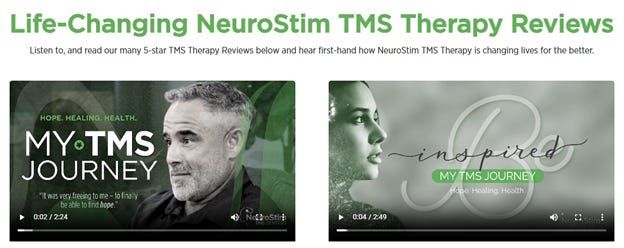
Most bizarrely, many TMS clinics use text, images, videos, and even (virtually) entire webpages produced directly by TMS device manufacturers with almost no disclosure of this fact. Consider the webpages below, which appears to come from the clinics themselves. Yes, this is NeuroStar ad copy that appears verbatim on countless clinic websites.
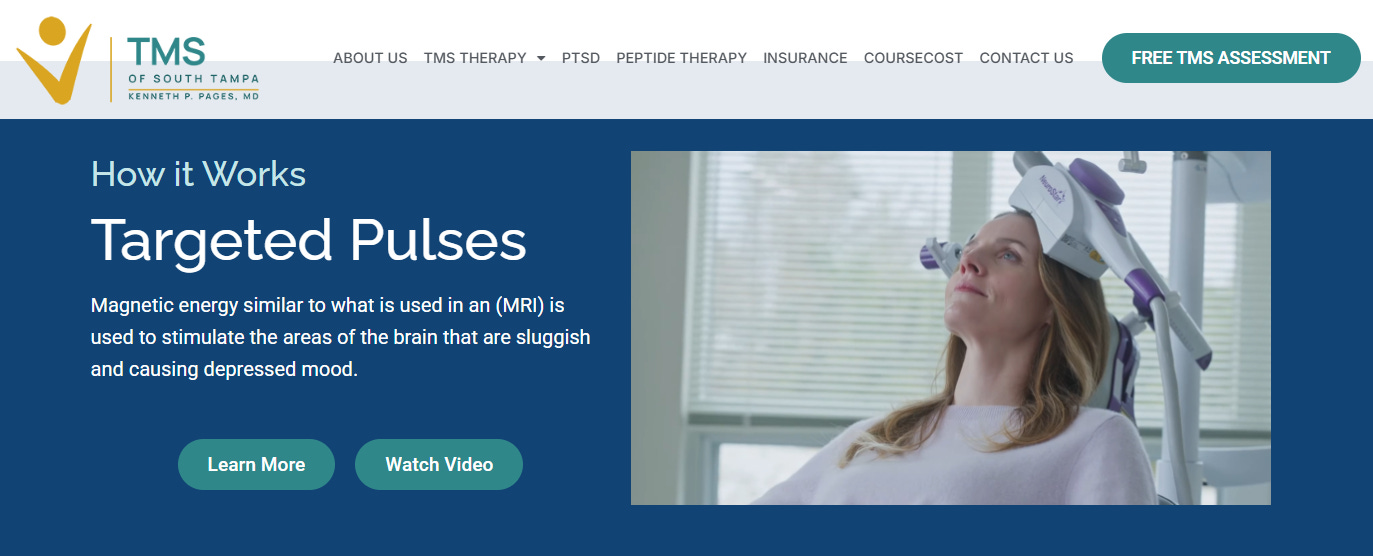

Imagine an outpatient psychiatry clinic whose website is literally ad copy for Vraylar with embedded Vraylar ads and videos of testimonials about how life-changing Vraylar was, all made by AbbVie with no disclosure of this fact. Imagine if a clinic website, which speaks from the voice of the clinician, was all written by AbbVie to sell Vraylar. Why is it acceptable for countless TMS clinics to copy the text of device companies with no disclosure? Here, I’ll leave you with NeuroStar ads patient testimonials on a clinic website.

This cannot be psychiatry
I am a psychiatrist who tries to do right by my patients. That means developing a thorough understanding of their challenges while working collaboratively and honestly with them. Patients trust me to describe research honestly, and to put their needs over any commercial incentives that can arise in medicine.8 This is the essential obligation of medicine.
Many TMS clinics represent the antithesis of this: hyperbolic descriptions of TMS like “life-changing” and “transformative;” exaggerated and dubious claims of efficacy using the veneer of science; promises that TMS will not just treat depression but transform your life; prompts to take a self-screening instrument to determine “if TMS is right for you;" and exhortations to get a “free consultation” and “no-obligation” calls—all paired with the overt suggestion that insurance will fund the treatment. To me, this is not medicine.
I understand why this marketing is used. These clinics present a simplified and appealing description of complex psychiatric problems: depression is a concrete entity that can be quickly fixed with TMS because of this revolutionary new technology. Sit in the chair for a few weeks and voilà, your depression is gone and you’ll be a transformed person!9

The inevitable loss of trust in psychiatry
I recognize that many clinicians truly believe in the efficacy of TMS, including close friends of mine. I think TMS can be a positive treatment option in psychiatry, even though I’m unimpressed by the evidence of distinct biological effects beyond those of sham (placebo) treatment. But even if you believe in TMS—especially if you believe in TMS—you cannot ignore how outlandish this marketing has become and the risk it poses to the credibility of TMS. You cannot ignore the commercial pressures shaping the field.
The first consequence is that every other mental health clinician has to compete against this marketing. When countless clinics portray TMS as “transformative” and “life-changing” with unbelievably high success rates, how can other psychiatrists or therapists offer competing models of care? I worry about a race to the bottom with aggressive and hyperbolic marketing. Already, I’m starting to see some TMS clinics advertise how they use a revolutionary approach that is faster and better than other clinics (all based on dubious research).
I worry that the legitimacy of psychiatry will be eroded. There is only so far our profession can deviate from the language of medicine before we lose our credibility. When psychiatric treatments are marketed in identical ways to wellness clinics offering treatments like NAD+ infusions and IV vitamins, we will increasingly be seen as a wellness industry rather than a medical specialty.

This will eventually invite backlash, much as we are seeing with antidepressants and MAHA. Perhaps it will only happen once the next novel treatment comes along to supplant TMS. But, at some point, the dissonance between the excessive marketing of TMS and its effectiveness will be noticed. Critics will accuse psychiatrists of putting commercial interests above honest communication to patients.
A new model of depression
The second, deeper consequence is that this marketing is creating a new cultural model of depression that is both concrete and unrealistic—much like the “chemical imbalance” model with SSRIs. Depression is a common, easily diagnosed problem caused by an “underactive mood center” or “sluggish” brain areas that TMS quickly and reliably corrects.10 As with antidepressants, the widespread adoption of TMS is dependent on patients believing in a model of depression which TMS would logically address.
Although this may sound extreme, we should not overlook the impact this narrative creation will have. The marketing of a “chemical imbalance” has done more to influence the popular understanding of depression than decades of NIH-funded research (or the handwringing of critical academics). The marketing of TMS (and ketamine) may represent the most influential new cultural narrative of depression in two decades.
Who will defend psychiatry?
We are witnessing the most meaningful change in the language and marketing of a psychiatric treatment since the heyday of the “chemical imbalance” model of SSRIs, with little collective consternation. It seems that there are powerful incentives for academics, practicing psychiatrists, and patients to all embrace interventional treatments, much as there were for SSRIs. But this does not make it right or good. If psychiatry is a medical specialty, then we need to accept the obligations of a medical specialty in how we describe psychiatric treatments to patients. It’s time that we speak up in defense of honest and accurate communication.
But wait, there’s more! Among the hundreds of quotes that I’ve gathered, other representative lines include that TMS is a “profoundly-effective treatment,” a “revolutionary treatment approach,” and a “life-changing treatment option.” TMS is an “investment in your mental wellness” and “your key to the life you deserve.” TMS “doesn’t just improve symptoms, it helps people regain their lives.” We learn that "For many, it has been life-changing — opening doors to joy, clarity, and a renewed sense of purpose.” I could go on ad infinitum.
I encourage you to compare these claims to the major TMS clinical trials, as I covered in Part 1.
“Example 49: The marketer of an electronic “ab sculpting” belt receives clearance from the FDA to sell the product as a Class II medical device for the intended purpose of stimulating and strengthening healthy muscle. The marketer airs an infomercial for the device with repeated references to the fact that the product is “FDA Approved,” alongside claims that “in just 10 minutes a day for 30 days, you can effortlessly lose two or more inches and 10 pounds from your waist.” The infomercial is deceptive because the juxtaposition of the “FDA Approved” reference and claims about weight loss and reduction in waist circumference gives the impression that the FDA has found the product to be effective for such dramatic effects.” Case in point.
The TMS page for another representative clinic has three links to a “see if TMS might be a fit” quiz, includes this same quiz in its entirety, has six separate buttons to “Schedule an Evaluation,” lists the clinic phone number nine times, and states that you will be contacted within one business day six separate times—all on this one page.
One quiz helpfully tells you “You may be a candidate for TMS. A consultation can confirm whether you meet your plan’s criteria,” which apparently is the ultimate arbiter or medical appropriateness.
It asks about a diagnosis of MDD, if you’ve seen a therapist, if you’ve taken medications, if you’re “still depressed,” if you’ve had side effects, if you’ve changed your meds, and if your depression impacts you functionally. Some integrate a PHQ-9 and questions about medical contraindications for TMS.
As a whole, clinics feature extensive information about what criteria insurance companies will use to approve TMS, along with quizzes providing this information. Clinics provide assurances about how staff will ensure your insurance eligibility.
This is how one free consultation is described: “Meet with one of our staff technicians to learn about TMS therapy and discuss your goals. We’ll review insurance or payment options and outline what to expect before treatment begins. This free consultation does not include treatment; the doctor is not present. Once approved, you’ll be scheduled for your initial mapping session with our Medical Director.” Here’s another “Symptom Review & TMS Suitability We begin by discussing your current mental health symptoms, their intensity, and how they impact your daily life and overall wellness. Our TMS Technician will ask preliminary questions regarding exclusion criteria for a physician review. This process guarantees your safety and verifies your specific clinical eligibility.”
Here’s how the FTC describes deceptive testimonials: “An overarching principle is that advertisers should not make claims through consumer testimonials or expert endorsements that would be deceptive or couldn’t be substantiated if the advertiser made them directly. It’s not enough that a testimonial represents the honest opinion or experience of an endorser. Under FTC law, advertisers also must have appropriate scientific evidence to back up the underlying implied claim that the product is effective and will work for buyers as it did for the endorser.” And “Testimonials that report results more dramatic than users can generally expect are likely to be deceptive. Moreover, attempts to disclaim dramatic results with statements like “Results not typical” don’t cure the deception. Those testimonials should be accompanied by a clear and conspicuous disclosure of the results a typical consumer can actually expect.”
As a salaried employee, I don’t have any.
I would joke that clinics make TMS seem like magic, but this comparison has literally been made. Again, “Have you ever wished for a magic wand to wave away depression or anxiety? While magic wands are still the stuff of fairy tales, transcranial magnetic stimulation (TMS) therapy might be the next best thing.”
I’ve collected scores of such metaphors from clinic websites
I'm interested in your take on Owen... Muir? A psychiatrist with bipolar who blogs on substack and is a hardcore advocate of (and financially invested in) SAINT TMS
"Patients would get the impression that depression is not a complex disorder that requires a thorough diagnostic history and careful appraisal of treatment options"
Most depression treatment consists of a psychiatrist prescribing a random SSRI rather than conducting a careful and thorough examination of the patient's mental health history and evaluating which treatment might be the best fit.